A look across the globe
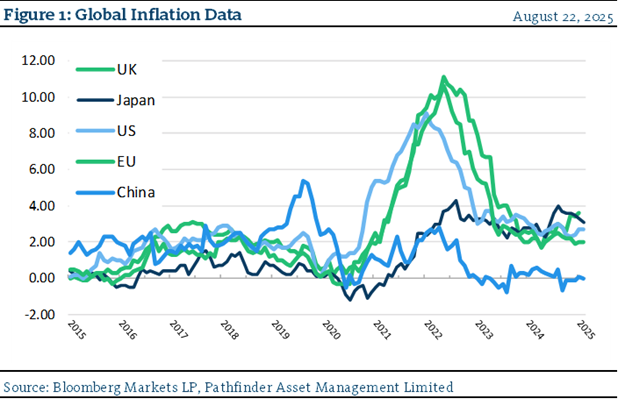
Last week, we wrote about U.S. inflation. This week, we thought we would compare the inflation data for other major world economies. Purchasing Managers’ Indices (PMI) from around the globe was also released this week. Recall that a reading above 50 indicates that business managers expect their organizations to expand over the next month, while a reading below 50 signals contraction.
- Figure 1 presents inflation data for the world’s major economies. As you can see, inflation has come down from its peak in 2022. Globally, we have stabilized between 2–3%. However, there has been an uptick in the most recently published data, which we noted last week, and that has contributed to some of the recent market volatility. China is the clear outlier and unfortunately, the market does not have much confidence in the validity of its numbers. This serves as a good example of why investors are concerned about the U.S. administration’s recent decision to change the head of the Bureau of Labor Statistics after unfavorable data was published.
- Figure 2 presents the PMI data we noted above and, as you can see, they are mostly trending higher since the start of the year. Interestingly, comments from the U.S. Federal Reserve Chair today have led to expectations of interest rate cuts to support a “balanced” employment situation. However, if we look at PMI numbers from around the globe, managers appear more constructive in their outlook. If rates are lowered and business continues to expand as managers believe, this combination would be very bullish for the stock market.

“This means that” we expect volatility to continue as investors work through the evolving global situation.
National Instrument 31-103 requires registered firms to disclose information that a reasonable investor would expect to know, including any material conflicts with the firm or its representatives. Doug Johnson and/or Pathfinder Asset Management Limited are an insider of companies periodically mentioned in this report. Please visit www.paml.ca for full disclosures.
Changes in Leverage. We are increasing the asset ceiling to 2.0 times the market value of equity for Pathfinder International Fund and Pathfinder Conviction Fund to be consistent with Pathfinder Partners’ Fund and Pathfinder Resource Fund.
For more information, please follow the links above to review the fund term sheets.
*All returns are time weighted and net of investment management fees. Returns from the Pathfinder Partners’ Fund and Partners’ Real Return Plus Fund are presented based on the masters series of each fund. The Pathfinder Core: Equity Portfolio and The Pathfinder Core: High Income Portfolio are live accounts. These are actual accounts owned by the Pathfinder Chairman (Equity) and client (High Income) which contain no legacy positions, cash flows or other Pathfinder investment mandates or products. Monthly inception dates for each fund and portfolio are as follows: Pathfinder Core: Equity Portfolio (January 2011), Pathfinder Core: High Income Portfolio (October 2012) Partners’ Fund (April 2011), Partners’ Real Return Plus Fund (April, 2013), and Partners’ Core Plus Fund (November 2014).
Pathfinder Asset Management Limited (PAML) and its affiliates may collectively beneficially own in excess of 10% of one or more classes of the issued and outstanding equity securities mentioned in this newsletter. This publication is intended only to convey information. It is not to be construed as an investment guide or as an offer or solicitation of an offer to buy or sell any of the securities mentioned in it. The author has taken all usual and reasonable precautions to determine that the information contained in this publication has been obtained from sources believed to be reliable and that the procedures used to summarize and analyze such information are based on approved practices and principles in the investment industry. However, the market forces underlying investment value are subject to sudden and dramatic changes and data availability varies from one moment to the next. Consequently, neither the author nor PAML can make any warranty as to the accuracy or completeness of information, analysis or views contained in this publication or their usefulness or suitability in any particular circumstance. You should not undertake any investment or portfolio assessment or other transaction on the basis of this publication, but should first consult your portfolio manager, who can assess all relevant particulars of any proposed investment or transaction. PAML and the author accept no liability of any kind whatsoever or any damages or losses incurred by you as a result of reliance upon or use of this publication.