At Least Two Sides to the Puzzle
Last week, we wrote about how strong the aggregate sales data for corporate North America was following the 2025 annual earnings season (here) so far. In addition to the data, we also reviewed management commentary from conference calls and presentations. While anecdotal, these insights are still very worthwhile. Below are several interesting snippets:
“Currently, the macro backdrop remains supportive, and the consumer remains resilient. The labor market is the key driver there. Business volumes, activity, and pipelines all remain very strong.” – JPMorgan, CFO Jeremy Barnum
“Across our customer base, spending continues to be resilient. In the U.S., we see the customer is choiceful in their spending.” – Walmart, CEO John Furner
“We survey our CEOs every quarter. Their optimism is at the highest level in over a year. And virtually none expect a recession in the next 12 months.” – Blackstone, CFO Michael Chae
Corporate earnings are definitely one side of the puzzle that an investor needs to pay attention to. Another is the geopolitical situation that has developed over the past five days in the Middle East. The initiation of hostilities by the U.S. and Israel has introduced another risk variable. Readers may know that the Strait of Hormuz is a maritime passage through which tankers travel as they exit the Middle East enroute to ports around the world, primarily in Asia and Europe. This narrow but deep-water corridor has been a source of concern since the early 1970s, when the first oil embargo triggered a crisis and economic disruption globally. As shown in Figure 1, the strait is essentially closed, indicated by the ships located in the red circles. According to The Straits Times, approximately 150–160 ships are currently holding on either side of the strait. There are many products critical to supply chains, not just oil & gas, that are stuck at this pinch point.
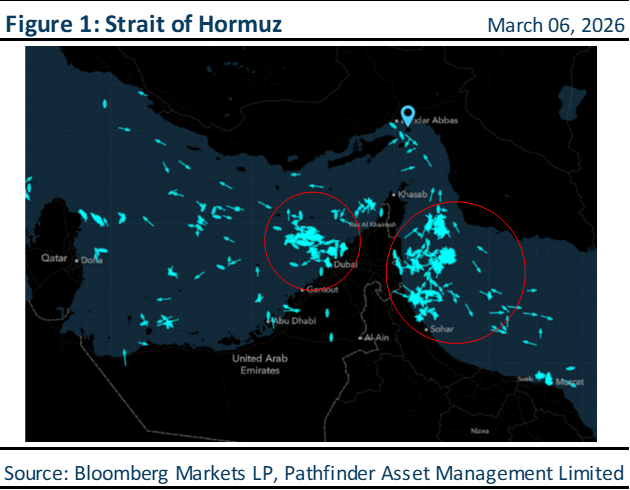
“This means that” investors should pay close attention to the evolution of this conflict. The longer Iran can keep the Strait of Hormuz impassable, the higher the risk that the optimistic outlooks above could change dramatically.
National Instrument 31-103 requires registered firms to disclose information that a reasonable investor would expect to know, including any material conflicts with the firm or its representatives. Doug Johnson and/or Pathfinder Asset Management Limited are an insider of companies periodically mentioned in this report. Please visit www.paml.ca for full disclosures.
Changes in Leverage. We are increasing the asset ceiling to 2.0 times the market value of equity for Pathfinder International Fund and Pathfinder Conviction Fund to be consistent with Pathfinder Partners’ Fund and Pathfinder Resource Fund.
For more information, please follow the links above to review the fund term sheets.
*All returns are time weighted and net of investment management fees. Returns from the Pathfinder Partners’ Fund and Pathfinder Conviction Fund are presented based on the master’s series of each fund. The Pathfinder North American Equity Portfolio and The Pathfinder North American Income Portfolio are live accounts. These are actual accounts owned by the Pathfinder Chairman (Equity) and client (High Income) which contain no legacy positions, cash flows or other Pathfinder investment mandates or products. Monthly inception dates for each fund and portfolio are as follows: Pathfinder North American Equity Portfolio (January 2011), Pathfinder North American High-Income Portfolio (October 2012) Pathfinder Partners’ Fund (April 2011), Pathfinder Conviction Fund (April 2013), and Pathfinder International Fund (November 2014).
Pathfinder Asset Management Limited (PAML) and its affiliates may collectively beneficially own in excess of 10% of one or more classes of the issued and outstanding equity securities mentioned in this newsletter. This publication is intended only to convey information. It is not to be construed as an investment guide or as an offer or solicitation of an offer to buy or sell any of the securities mentioned in it. The author has taken all usual and reasonable precautions to determine that the information contained in this publication has been obtained from sources believed to be reliable and that the procedures used to summarize and analyze such information are based on approved practices and principles in the investment industry. However, the market forces underlying investment value are subject to sudden and dramatic changes and data availability varies from one moment to the next. Consequently, neither the author nor PAML can make any warranty as to the accuracy or completeness of information, analysis or views contained in this publication or their usefulness or suitability in any particular circumstance. You should not undertake any investment or portfolio assessment or other transaction on the basis of this publication, but should first consult your portfolio manager, who can assess all relevant particulars of any proposed investment or transaction. PAML and the author accept no liability of any kind whatsoever or any damages or losses incurred by you as a result of reliance upon or use of this publication.