Global Stock Market Valuations
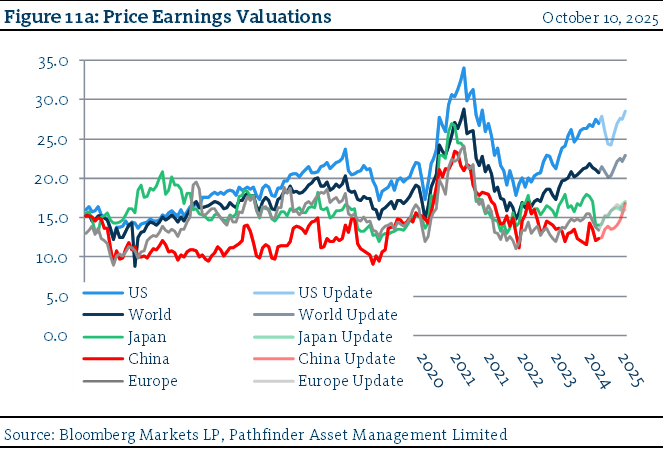
Yesterday we had an interesting discussion about putting capital to work in the current investment environment. The question was, “Given how high markets are, should new money be invested in the market right away or should it wait in cash in on the sidelines and invested after a future potential correction”. As part of the discussion, we referenced Figure 11. This chart was part of our 2024 Annual Review published at the beginning of 2025. We wanted to demonstrate that at the beginning of the year, valuations were very high, especially in the US (light blue line). At the start of year, we concluded that it would be difficult for the market to continue for yet another year with double digit returns. Well, that is exactly what has happened. After a difficult start, world markets have raced past previous highs and produced just under 15% in Canadian dollars so far this year.

One request in our discussion was if we could update the chart for the current period to help with the review. We did that and present the results in Figure 11a (lighter lines are the update). Valuations, after the blip around “Liberation Day” have raced even higher. Indeed, the US is approaching 30x.
“This means that” no one really knows when the best time to invest capital in the stock market is. The best that we can do is find great companies and buy those companies when they are at a fair price. At the start of the year, companies in Japan, China and Europe offered good value. The US did not. There was also a chance to invest opportunistically during the correction in April, but most investors did not have the fortitude to do that. Our mandates did benefit from buying at that time, and also by allocating internationally, but we did not do that by timing the market. We did it by staying disciplined. In our opinion, measured investment process, with a long-term view, is the best way to deploy capital in any market.
National Instrument 31-103 requires registered firms to disclose information that a reasonable investor would expect to know, including any material conflicts with the firm or its representatives. Doug Johnson and/or Pathfinder Asset Management Limited are an insider of companies periodically mentioned in this report. Please visit www.paml.ca for full disclosures.
Changes in Leverage. We are increasing the asset ceiling to 2.0 times the market value of equity for Pathfinder International Fund and Pathfinder Conviction Fund to be consistent with Pathfinder Partners’ Fund and Pathfinder Resource Fund.
For more information, please follow the links above to review the fund term sheets.
*All returns are time weighted and net of investment management fees. Returns from the Pathfinder Partners’ Fund and Partners’ Real Return Plus Fund are presented based on the masters series of each fund. The Pathfinder Core: Equity Portfolio and The Pathfinder Core: High Income Portfolio are live accounts. These are actual accounts owned by the Pathfinder Chairman (Equity) and client (High Income) which contain no legacy positions, cash flows or other Pathfinder investment mandates or products. Monthly inception dates for each fund and portfolio are as follows: Pathfinder Core: Equity Portfolio (January 2011), Pathfinder Core: High Income Portfolio (October 2012) Partners’ Fund (April 2011), Partners’ Real Return Plus Fund (April, 2013), and Partners’ Core Plus Fund (November 2014).
Pathfinder Asset Management Limited (PAML) and its affiliates may collectively beneficially own in excess of 10% of one or more classes of the issued and outstanding equity securities mentioned in this newsletter. This publication is intended only to convey information. It is not to be construed as an investment guide or as an offer or solicitation of an offer to buy or sell any of the securities mentioned in it. The author has taken all usual and reasonable precautions to determine that the information contained in this publication has been obtained from sources believed to be reliable and that the procedures used to summarize and analyze such information are based on approved practices and principles in the investment industry. However, the market forces underlying investment value are subject to sudden and dramatic changes and data availability varies from one moment to the next. Consequently, neither the author nor PAML can make any warranty as to the accuracy or completeness of information, analysis or views contained in this publication or their usefulness or suitability in any particular circumstance. You should not undertake any investment or portfolio assessment or other transaction on the basis of this publication, but should first consult your portfolio manager, who can assess all relevant particulars of any proposed investment or transaction. PAML and the author accept no liability of any kind whatsoever or any damages or losses incurred by you as a result of reliance upon or use of this publication.