Is the US Multitasking in Risk?
Headlines are dominated by the War in Iran and the on-again off-again prospects for a quick end to the conflict. We do not see the price of oil ‘seesaw’ in this manner very often. While there have been significant historical shocks (COVID-19, the Great Financial Crisis, etc.) that reset medium-term prices dramatically, those tended to be large, single-event shocks that moved the commodity in one direction. In contrast, we are now seeing 5%–10% swings in both directions daily. As we noted in previous issues, we are concerned that while headlines remain focused on events in the Middle East, investors have become too sanguine. Other critical issues are being overlooked.
- The War in Iran: The primary risk is a prolonged closure of the Strait of Hormuz. While the impact on the available oil supply has been described as the largest in history, other vital components of the global economy are also at risk. These include refined products (Australia), liquefied natural gas (Asia & Europe), various fertilizer components (Northern Hemisphere spring planting), petrochemicals (naphtha, sulfur, and methanol) critical for plastics, batteries, and construction, and helium (vital for semiconductors and industrial products).
- Private Credit in Distress: Since the GFC, new capital requirements have pushed ‘risky private loans‘ away from traditional banks and toward private credit funds and alternative asset managers. Several prominent funds have struggled, prompting redemption This has forced managers to restrict withdrawals, triggering mini ‘runs on the bank.’ While this is not ‘GFC 2.0’—the new regulations have protected the traditional banking system—it remains a risk for financial contagion and is likely a symptom of our next point: the U.S. economy.
- US Economy at Risk: While we previously highlighted robust corporate earnings, more broad economic headwinds appear to have been overlooked by investors. Weakening labor (Non-Farm, services and manufacturing hiring expectations), slowing GDP, and ‘sticky’ inflation (even before the Iran issues).
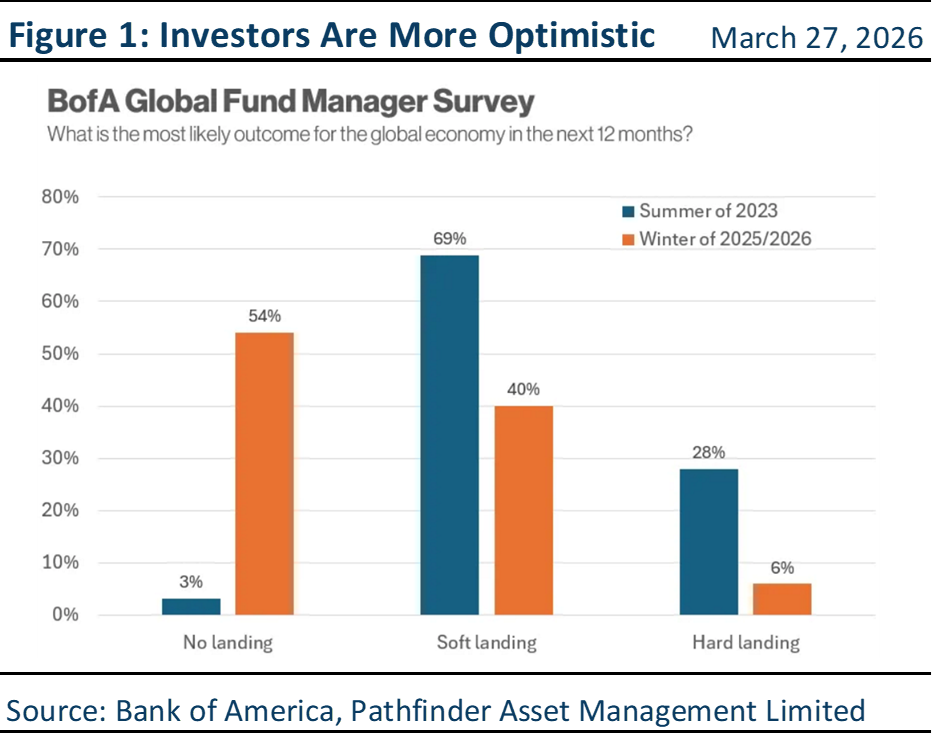
“This means that” as you can see in Figure 1, investors have become more optimistic that the US would not have a hard landing and recession. The stock market responded in kind. We believe this is a risky setup as investors will ultimately realize the issues above are real and financial asset prices are too high.
National Instrument 31-103 requires registered firms to disclose information that a reasonable investor would expect to know, including any material conflicts with the firm or its representatives. Doug Johnson and/or Pathfinder Asset Management Limited are an insider of companies periodically mentioned in this report. Please visit www.paml.ca for full disclosures.
Changes in Leverage. We are increasing the asset ceiling to 2.0 times the market value of equity for Pathfinder International Fund and Pathfinder Conviction Fund to be consistent with Pathfinder Partners’ Fund and Pathfinder Resource Fund.
For more information, please follow the links above to review the fund term sheets.
*All returns are time weighted and net of investment management fees. Returns from the Pathfinder Partners’ Fund and Pathfinder Conviction Fund are presented based on the master’s series of each fund. The Pathfinder North American Equity Portfolio and The Pathfinder North American Income Portfolio are live accounts. These are actual accounts owned by the Pathfinder Chairman (Equity) and client (High Income) which contain no legacy positions, cash flows or other Pathfinder investment mandates or products. Monthly inception dates for each fund and portfolio are as follows: Pathfinder North American Equity Portfolio (January 2011), Pathfinder North American High-Income Portfolio (October 2012) Pathfinder Partners’ Fund (April 2011), Pathfinder Conviction Fund (April 2013), and Pathfinder International Fund (November 2014).
Pathfinder Asset Management Limited (PAML) and its affiliates may collectively beneficially own in excess of 10% of one or more classes of the issued and outstanding equity securities mentioned in this newsletter. This publication is intended only to convey information. It is not to be construed as an investment guide or as an offer or solicitation of an offer to buy or sell any of the securities mentioned in it. The author has taken all usual and reasonable precautions to determine that the information contained in this publication has been obtained from sources believed to be reliable and that the procedures used to summarize and analyze such information are based on approved practices and principles in the investment industry. However, the market forces underlying investment value are subject to sudden and dramatic changes and data availability varies from one moment to the next. Consequently, neither the author nor PAML can make any warranty as to the accuracy or completeness of information, analysis or views contained in this publication or their usefulness or suitability in any particular circumstance. You should not undertake any investment or portfolio assessment or other transaction on the basis of this publication, but should first consult your portfolio manager, who can assess all relevant particulars of any proposed investment or transaction. PAML and the author accept no liability of any kind whatsoever or any damages or losses incurred by you as a result of reliance upon or use of this publication.