Longer than expected
Market stress continues alongside ongoing hostilities in the Middle East. The headlines certainly make for interesting reading and have sparked significant discussion around the desk. While we do not address politics in this note—preferring to ‘stick to the stocks’—there are a few points we would like to highlight to give you a better understanding of our current view.
The primary concern for us—and, we believe, for most investors—is the reopening of the Strait of Hormuz. This is critical because, while the headlines tend to focus on oil, the world has become increasingly dependent on the Middle East for Liquefied Natural Gas (LNG) and key components of the fertilizer complex (nitrogen, urea, and methane, which are used as a feedstock for amonia). Furthermore, chemicals like helium are vital for semiconductor manufacturing. Lastly, oil remains a major input for the plastics and resins used in everyday products.
A substantial portion of these materials traverse the Strait daily; with that flow now halted, the eventual result will be upward pressure on prices and, consequently, inflation. This will feed directly into a U.S. economy that, were it not for the focus on the war, would likely dominate the headlines due to its clear weakening (see recent employment and consumer data). To add to this, we believe investors have been complacent about a potential recession, so the set up if his were to occur, would make for a violent downside reaction in risk assets.
Figure 1 presents the issue. While the oil and LNG takers have stopped going through the Strait, a few regular cargo ships (i.e. lower risk for full explosion) have tried. This is a Thai cargo ship hit just above the water line by Iranian missiles, one of thee hit that day. All it takes is regular strikes like this and Iran can keep the Strait closed as long as it wants.
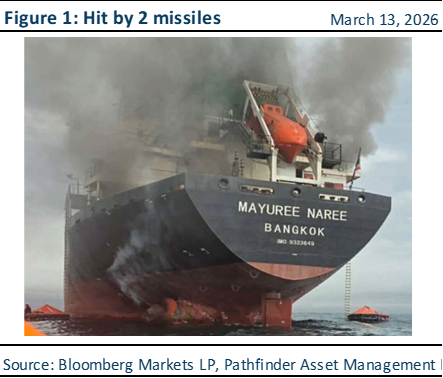
“This means that” according to Sun Tzu; “To fight and conquer in all your battles is not supreme excellence; supreme excellence consists in breaking the enemy’s resistance without fighting.”. A clever way to defeat a stronger opponent is to make waging war far more costly for your opponent than it is for yourself. It seems that this is Iran’s approach and, in this situation, they do get a vote. It will not be as easy as the US just declaring “Mission Accomplished” and everyone getting back to normal. We fear this will last longer and be more painful.
National Instrument 31-103 requires registered firms to disclose information that a reasonable investor would expect to know, including any material conflicts with the firm or its representatives. Doug Johnson and/or Pathfinder Asset Management Limited are an insider of companies periodically mentioned in this report. Please visit www.paml.ca for full disclosures.
Changes in Leverage. We are increasing the asset ceiling to 2.0 times the market value of equity for Pathfinder International Fund and Pathfinder Conviction Fund to be consistent with Pathfinder Partners’ Fund and Pathfinder Resource Fund.
For more information, please follow the links above to review the fund term sheets.
*All returns are time weighted and net of investment management fees. Returns from the Pathfinder Partners’ Fund and Pathfinder Conviction Fund are presented based on the master’s series of each fund. The Pathfinder North American Equity Portfolio and The Pathfinder North American Income Portfolio are live accounts. These are actual accounts owned by the Pathfinder Chairman (Equity) and client (High Income) which contain no legacy positions, cash flows or other Pathfinder investment mandates or products. Monthly inception dates for each fund and portfolio are as follows: Pathfinder North American Equity Portfolio (January 2011), Pathfinder North American High-Income Portfolio (October 2012) Pathfinder Partners’ Fund (April 2011), Pathfinder Conviction Fund (April 2013), and Pathfinder International Fund (November 2014).
Pathfinder Asset Management Limited (PAML) and its affiliates may collectively beneficially own in excess of 10% of one or more classes of the issued and outstanding equity securities mentioned in this newsletter. This publication is intended only to convey information. It is not to be construed as an investment guide or as an offer or solicitation of an offer to buy or sell any of the securities mentioned in it. The author has taken all usual and reasonable precautions to determine that the information contained in this publication has been obtained from sources believed to be reliable and that the procedures used to summarize and analyze such information are based on approved practices and principles in the investment industry. However, the market forces underlying investment value are subject to sudden and dramatic changes and data availability varies from one moment to the next. Consequently, neither the author nor PAML can make any warranty as to the accuracy or completeness of information, analysis or views contained in this publication or their usefulness or suitability in any particular circumstance. You should not undertake any investment or portfolio assessment or other transaction on the basis of this publication, but should first consult your portfolio manager, who can assess all relevant particulars of any proposed investment or transaction. PAML and the author accept no liability of any kind whatsoever or any damages or losses incurred by you as a result of reliance upon or use of this publication.