Pathfinder Small Cap Quarterly Report
SEPTEMBER 30, 2026
The Pathfinder Small Cap mandates invest in high-torque, early-stage companies that have the potential to generate superior returns.
Pathfinder Partners’ Fund
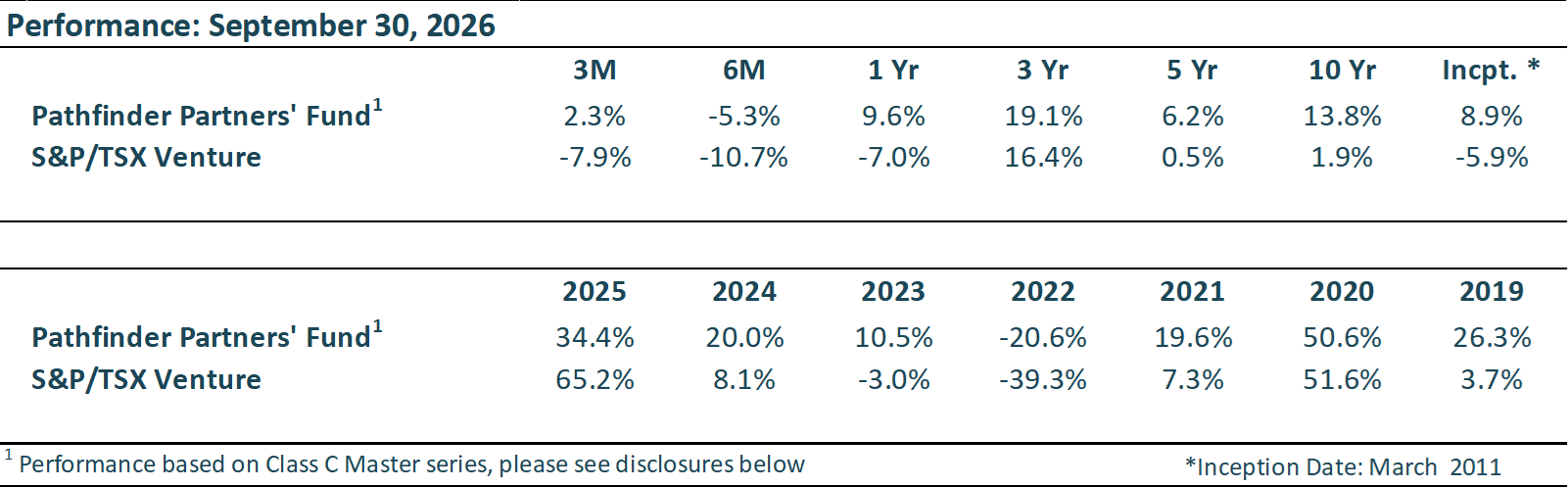
The Partners’ Fund had a net return of +2.3% in the third quarter of 2026. This compares to the TSX Venture Exchange which had a return of -7.9% in the third quarter. Our annualized 10-year return is +13.8% compared to the TSX Venture Exchange’s return of +1.9% over the same period. The table below provides the performance summary.
Our top contributor for the quarter Brent crude oil futures, Libertystream Infrastructure Partners Ltd. (TSXv:LIB), and Delcath Systems Inc (NASDAQ:DCTH). Our main detractors were Sylogist Ltd (TSX:SYZ) and Modular Medical Inc (NASDAQ:MODD).
We believe the current macroeconomic environment is still carrying systemic risk that is worth hedging against. The US-Iran war continues to pressure energy prices leaving oil near decade highs; the bond market is sending one of the strongest signals, with the “risk-free” US 10-year Treasury yield hovering around 5%, matching levels we haven’t seen in 20 years. Equity index performance doesn’t seem to reflect this growing cost of capital and the reason for this is a handful of mega-cap companies that are buoying the equity markets and masking the underlying weakness of most companies.
The “AI build-out” dominated the market narrative in Q3 with expected annual capex spend to reach and exceed the trillion-dollar mark over the next 1-2 years, and while that’s great for boosting short-term GDP, we’ve yet to be convinced that the spend will translate into the near-term returns required by investors. We are continuing to pursue a defensive-weighted strategy in anticipation of a market correction providing attractive buying opportunities.
In Q3 we added to our technology holdings in our belief that providers of both hardware and software will survive the “vibe-coded” SaaSpocalype that’s continuing to put pressure on software providers. We expanded our specialty pharma holdings on our bullish view of new product launches and growing demand from what we see as an ageing demographic that will require more customized and complex treatments. We continued to participate in biotechnology financings, and to further our diversification we are engaged with some exciting companies across the technology and biotech space that we hope to be able to talk about in a future note.
Aiming to reduce our exposure to market volatility while keeping our cash working for our shareholders, in September we organized a secured loan to LibertyStream Infrastructure Partners Ltd. (LIB.TSXv), a materials technology company deploying Direct Lithium Extraction (DLE) technology in the Permian and Delaware basin. We’ve mentioned them before in our quarterly, but here is a refresher: unlike other lithium projects that look to extract from hard-rock, clays, or solar brines, LIB brings their DLE to existing oilfield-brine infrastructure operators, such as Select Water Solutions, Inc (WTTR.NYSE), and allows them to “bolt-on” LIB’s DLE and extract lithium, generating revenue from what is currently viewed as a waste stream. While we think it’s unrealistic to assume they’ll capture every barrel of water from WTTR, we think they’ll expand their partnership to include more midstreamers and eventually process millions of barrels from a variety of brine injection locations.
LIB has reached a technology readiness level (TRL) no other oilfield DLE explorer has achieved, going from lab analysis to on-site continuous production of battery-grade lithium carbonate. The high-purity product is undergoing validation testing with potential offtakers receiving multi-ton samples, and while this qualification is time-intensive due to the unique lithium “recipe” required by each customer, it establishes a moat that leaves peers both years and hundreds of millions of dollars in spend away from a similar stage. We believe the asymmetrical upside of a multi-billion dollar market cap more than offsets the remaining scale-up risks. Near-term catalysts on their scaled-up operations are expected in Q4, with definitive proof of success by Q1 or Q2 2027.
The broad market is being supported by a few pillars whose cracks are starting to show, but this doesn’t provide timing or a guarantee that a market correction will occur. Ultimately, we think the portfolio is well positioned to provide quality equity exposure while our active tactical hedging protects against downside risks stemming from AI overspending, higher interest rates, and high energy (oil and gas) prices.
Pathfinder Resource Fund
The Resource Fund had a net return of 8.2% in the third quarter of 2026. This compares to the benchmark which had a net return of +14.6% for the third quarter. Since inception (July 16, 2018), the Resource Fund has returned +21.3% annualized versus the benchmark’s return of +15.1%. The table below provides the performance summary.

Positive contribution for the quarter came primarily from Brent crude oil futures and Oil & Gas equities. Our main detractors were Nexmetals Mining Corp (TSXv:NEXM) and Blue Moon Metals Inc (TSX:MOON).
This quarter has been challenging, with heightened volatility driven by headline risk and shifting market sentiment. Many companies across the sector are now trading well below their 52-week highs, underscoring the importance of disciplined capital allocation in the current environment. In our view, markets remain in a holding pattern as investors assess the evolving risks and look for clearer market/government signals.
As discussed in previous quarterly reports, our strategy at the start of the year was to reduce risk by trimming early-stage junior mining holdings and concentrating on our core positions where we have the highest conviction, while building a meaningful cash position. This strategy has reduced the portfolio’s upside torque, but is helping us preserve gains from previous quarters. Due to recent volatility, valuations are becoming increasingly attractive, and we continue to actively assess opportunities, while being very selective and disciplined in deploying capital.
Where do we go from here? Gold has pulled back from its all-time highs at the start of the year but has traded sideways amid the potential for rising interest rates and a strengthening US dollar. Copper has outperformed due to tariff threats and may give back some gains in the short term; however, the long-term fundamentals remain strong.
Uranium is very attractive as global governments recognize the importance of inexpensive, clean, and reliable energy amid growing demand. The critical elements space has also gained attention, but it remains a relatively niche market, and we need to consider the effect on demand as mines come online. We also need to consider refining and processing, which have been the main bottlenecks. Therefore, we remain cautious on overexposure to critical elements and are focused on near-term production scenarios. For example, we discussed Blue Moon Metals (TSXV: MOON) in our last quarterly report, and we believe the Company could be the next to receive US government backing, similar to MP Materials based on the quality of assets but also ability to produce a downstream product.
Despite the market uncertainty, our goal is to remain patient and wait for a buyer’s market. We have recently been inundated with recycled projects or low-grade projects that never made the cut durig previous commodity cycles, so we are being extremely conservative initiating on new deals. This scenario can signal a market top so caution is advised as good quality projects become difficult to find. As investors, we need to recognize that rising commodity prices do not necessarily translate into higher margins for exploration companies or producers, as costs always rise alongside them.
The past 12 months have been lucrative for producers benefiting from higher commodity prices. However, rising fuel prices amid the Middle East conflict and the Russia-Ukraine war are putting pressure on operating costs. As a result, margins are beginning to shrink, leading us to believe that producers could see net income decline despite previously healthy margins. Our goal is to monitor this situation closely and use our cash position to capitalize on opportunities to initiate positions in high-conviction companies that have been oversold due to macroeconomic factors rather than deteriorating fundamentals.
A company that has been out of favour recently despite positive recent developments is Magna Mining Inc. (TSX.NICU). NICU is an emerging Sudbury based copper-nickel producer with offtake agreements with the likes of Glencore and Vale. The company is already generating cash flow from McCreedy West but has recently tabled an economic report and approved the restart of Levack, a second mine that will bolster production. The company also received a capital injection by Alpayana’s C$140 M strategic investment which lends credibility to the execution and growth Magna is expected to achieve. We believe Magna is positioned to advance its multi-asset portfolio, with the potential for a valuation re-rating as Levack progresses toward production and the company demonstrates its ability to grow cash flow.
The portfolio remains defensively positioned to navigate potential further market weakness. At the same time, our strong cash position provides the flexibility to selectively deploy capital across sectors as opportunities emerge, allowing us to capitalize on attractive valuations while maintaining a disciplined approach to risk management. As always, we appreciate your trust and support. Thank you.
National Instrument 31-103 requires registered firms to disclose information that a reasonable investor would expect to know, including any material conflicts with the firm or its representatives. Doug Johnson and/or Pathfinder Asset Management Limited are an insider of companies periodically mentioned in this report. Please visit www.paml.ca for full disclosures.
* All returns are time weighted and net of investment management fees. Returns from the Pathfinder Partners’ Fund are presented based on the Class C Master series except prior to its inception in July 2011 when the Class A Master series was used. Inception returns include the 10 months from inception in March 2011. Returns greater than one year are annualized. Returns from the Pathfinder Resource Fund are presented based on the Class C Master series since its inception in July 16, 2018. The S&P/TSX Venture Composite Index (C$), the S&P/TSX Venture Composite Index, the S&P/TSX Capped Materials Index and the S&P/TSX Capped Energy Index provide general information and should not be interpreted as a benchmark for your own portfolio return. Further details of the Partners’ Fund are available on request.
Changes in Leverage. We are increasing the asset ceiling to 2.0 times the market value of equity for Pathfinder International Fund and Pathfinder Conviction Fund to be consistent with Pathfinder Partners’ Fund and Pathfinder Resource Fund.
Pathfinder Asset Management Limited (PAML) and its affiliates may collectively beneficially own in excess of 10% of one or more classes of the issued and outstanding equity securities mentioned in this newsletter. This publication is intended only to convey information. It is not to be construed as an investment guide or as an offer or solicitation of an offer to buy or sell any of the securities mentioned in it. The author has taken all usual and reasonable precautions to determine that the information contained in this publication has been obtained from sources believed to be reliable and that the procedures used to summarize and analyze such information are based on approved practices and principles in the investment industry. However, the market forces underlying investment value are subject to sudden and dramatic changes and data availability varies from one moment to the next. Consequently, neither the author nor PAML can make any warranty as to the accuracy or completeness of information, analysis or views contained in this publication or their usefulness or suitability in any particular circumstance. You should not undertake any investment or portfolio assessment or other transaction on the basis of this publication, but should first consult your portfolio manager, who can assess all relevant particulars of any proposed investment or transaction. PAML and the author accept no liability of any kind whatsoever or any damages or losses incurred by you as a result of reliance upon or use of this publication.