Soft Landing In Doubt
Recently US employment numbers made their way into the mainstream media headlines mainly because the US administration replaced the head of the department that produces the jobs numbers after a few months of less than stellar data releases. We, like many other investors, pay close attention to employment reports, as well as inflation data. That is because the management of those two parts of the economy is the central mandate of the Federal Open Market Committee (FOMC), and the level interest rates set by the FOMC is critical to financial asset valuations.
Figure 1 presents monthly change in payrolls in the US. The blue line is total new jobs created each month, and the green line is jobs that come from the private sector. The monthly number is quite volatile, so we have smoothed it by taking a three-month average. As you cans see, total job creation has come down from the post-COIVD period (where it was an outlier). A more typical number for a good functioning economy is about 200k per month. A close review of the chart reveals that the economy was producing 200k from about April of 2023. From the start of 2025, the trend has clearly changed.
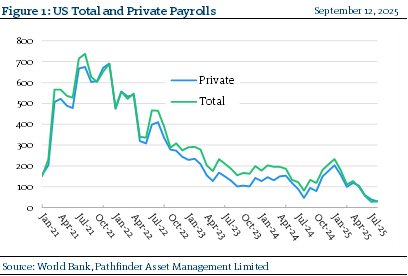
Figure 2 presents forward investor expectations of where the US administered interest rates. The blue line presents expectations for the December FOMC meeting and the green line is for September. As you can see, interest rate expectations have clearly started a downward trend. This means the market expects the FOMC will lower rates. We believe they would do this mostly because they are concerned about employment growth. Looser policy could potentially spark economic development and increase employment.

“This means that” while we were quite comfortable that the previous US administration had the real potential of engineering a soft landing for the US economy, things have clearly changed. For some time now, we have been worried about financial market valuations and weak employment is another concern. Our mandates have taken the opportunity to raise cash and increase investment in defensive positions. We remain laser focused on out investment management process.
National Instrument 31-103 requires registered firms to disclose information that a reasonable investor would expect to know, including any material conflicts with the firm or its representatives. Doug Johnson and/or Pathfinder Asset Management Limited are an insider of companies periodically mentioned in this report. Please visit www.paml.ca for full disclosures.
Changes in Leverage. We are increasing the asset ceiling to 2.0 times the market value of equity for Pathfinder International Fund and Pathfinder Conviction Fund to be consistent with Pathfinder Partners’ Fund and Pathfinder Resource Fund.
For more information, please follow the links above to review the fund term sheets.
*All returns are time weighted and net of investment management fees. Returns from the Pathfinder Partners’ Fund and Partners’ Real Return Plus Fund are presented based on the masters series of each fund. The Pathfinder Core: Equity Portfolio and The Pathfinder Core: High Income Portfolio are live accounts. These are actual accounts owned by the Pathfinder Chairman (Equity) and client (High Income) which contain no legacy positions, cash flows or other Pathfinder investment mandates or products. Monthly inception dates for each fund and portfolio are as follows: Pathfinder Core: Equity Portfolio (January 2011), Pathfinder Core: High Income Portfolio (October 2012) Partners’ Fund (April 2011), Partners’ Real Return Plus Fund (April, 2013), and Partners’ Core Plus Fund (November 2014).
Pathfinder Asset Management Limited (PAML) and its affiliates may collectively beneficially own in excess of 10% of one or more classes of the issued and outstanding equity securities mentioned in this newsletter. This publication is intended only to convey information. It is not to be construed as an investment guide or as an offer or solicitation of an offer to buy or sell any of the securities mentioned in it. The author has taken all usual and reasonable precautions to determine that the information contained in this publication has been obtained from sources believed to be reliable and that the procedures used to summarize and analyze such information are based on approved practices and principles in the investment industry. However, the market forces underlying investment value are subject to sudden and dramatic changes and data availability varies from one moment to the next. Consequently, neither the author nor PAML can make any warranty as to the accuracy or completeness of information, analysis or views contained in this publication or their usefulness or suitability in any particular circumstance. You should not undertake any investment or portfolio assessment or other transaction on the basis of this publication, but should first consult your portfolio manager, who can assess all relevant particulars of any proposed investment or transaction. PAML and the author accept no liability of any kind whatsoever or any damages or losses incurred by you as a result of reliance upon or use of this publication.