Strait Up Risky
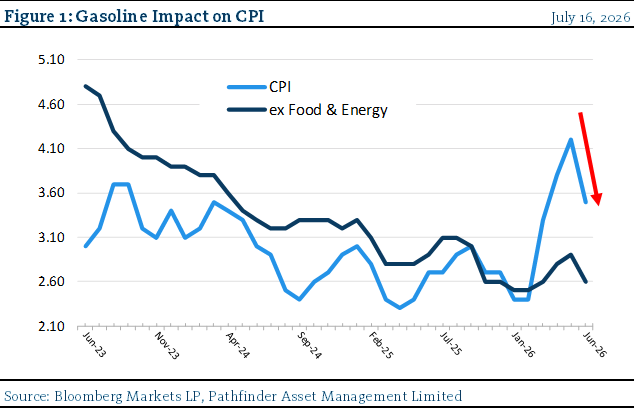
We have spent some time recently writing about inflation and the energy markets. The situation changed (again), so we revisit (again) this week. On Tuesday of last week, June CPI was reported and fell 0.4%, the largest monthly decline since April 2020. The annual CPI rate also fell to 3.5% from 4.2% (Figure 1). This was a surprise drop, but composition matters. Energy was the largest contributor to the decline, falling 5.7%, mostly from gasoline and can be attributed to crude sliding from above $90 to roughly $73 over the course of June. With hostilities reignited this week, crude back above $100, and crack spreads at all time highs, June is likely to be the floor, rather than the start of a new trend.
Last week, we also read in the Financial Times that Ukraine’s Unmanned Systems Forces (i.e. their drones), had struck 105 Russian shadow fleet vessels in the Sea of Azov. The Ukraine military said that Russia’s “transshipment infrastructure is taking hits every night” and that “traffic through the Kerch strait has been halted”. This, in combination with 2 other long-range targeted actions, means that 3 of Russia’s 4 seaborn egress facilities are closed. The government there has responded with internal fuel restrictions and emergency gasoline imports from India. The drone attacks will directly impact shipments to China, where their “teapot refineries” have long taken sanction Russian barrels at well below market prices. We thought this was very interesting and wanted to see the other parts of the world that had similar risk, so we produced Figure 2. The coloured dots indicate the potential risk of closure from lack of alternate maritime egress (green = low & red = high), while the size of the circle indicates the economic value. The other risk point is Bab-el-Mandeb, the 29 km wide Yemen–Djibouti gateway to the Red Sea and Suez, which this week Iran announced it would also attack. Closing this point would impact 4.2 million barrels per day (already down from 9.3M in 2023) as well as all of the pipeline egress built by Saudi and UAE to bypass Hormuz.
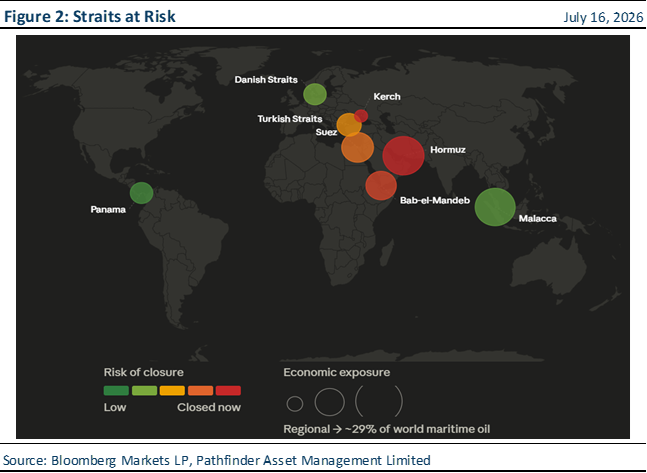
“This means that” Iran has taught the world that cheap drones have changed free access to seaborne shipping. Effectively, any tight waterway is at risk. We believe that war-risk insurance and the general risk premium embedded in freight rates is structurally higher, as is the risk to supply chain logistics. Inflation can only go higher.
National Instrument 31-103 requires registered firms to disclose information that a reasonable investor would expect to know, including any material conflicts with the firm or its representatives. Doug Johnson and/or Pathfinder Asset Management Limited are an insider of companies periodically mentioned in this report. Please visit www.paml.ca for full disclosures.
Changes in Leverage. We are increasing the asset ceiling to 2.0 times the market value of equity for Pathfinder International Fund and Pathfinder Conviction Fund to be consistent with Pathfinder Partners’ Fund and Pathfinder Resource Fund.
Telephone Call Recording Reminder. To maintain accurate records and support quality service, please note that all telephone calls with our office are recorded, in accordance with applicable privacy laws.
For more information, please follow the links above to review the fund term sheets.
*All returns are time weighted and net of investment management fees. Returns from the Pathfinder Partners’ Fund and Pathfinder Conviction Fund are presented based on the master’s series of each fund. The Pathfinder North American Equity Portfolio and The Pathfinder North American Income Portfolio are live accounts. These are actual accounts owned by the Pathfinder Chairman (Equity) and client (High Income) which contain no legacy positions, cash flows or other Pathfinder investment mandates or products. Monthly inception dates for each fund and portfolio are as follows: Pathfinder North American Equity Portfolio (January 2011), Pathfinder North American High-Income Portfolio (October 2012) Pathfinder Partners’ Fund (April 2011), Pathfinder Conviction Fund (April 2013), and Pathfinder International Fund (November 2014).
Pathfinder Asset Management Limited (PAML) and its affiliates may collectively beneficially own in excess of 10% of one or more classes of the issued and outstanding equity securities mentioned in this newsletter. This publication is intended only to convey information. It is not to be construed as an investment guide or as an offer or solicitation of an offer to buy or sell any of the securities mentioned in it. The author has taken all usual and reasonable precautions to determine that the information contained in this publication has been obtained from sources believed to be reliable and that the procedures used to summarize and analyze such information are based on approved practices and principles in the investment industry. However, the market forces underlying investment value are subject to sudden and dramatic changes and data availability varies from one moment to the next. Consequently, neither the author nor PAML can make any warranty as to the accuracy or completeness of information, analysis or views contained in this publication or their usefulness or suitability in any particular circumstance. You should not undertake any investment or portfolio assessment or other transaction on the basis of this publication, but should first consult your portfolio manager, who can assess all relevant particulars of any proposed investment or transaction. PAML and the author accept no liability of any kind whatsoever or any damages or losses incurred by you as a result of reliance upon or use of this publication.