The Silent Treatment
Regular readers of the Outlook will know that we often write about the US Federal Open Marekt Committee (FOMC), which administers US interest rates by setting an overnight target range for inter-bank interest rates. This is important because the level ripples indirectly into everything from credit cards to mortgage rates. As “the US consumer” is approximately two thirds of the economy, the amount of interest that people pay has a direct impact on the amount that they spend. This week, the big news was what the new Federal Reserve chair, Mr Kevin Warsh, chose not to say after the FOMC’s decision to hold rates unchanged. Warsh said the Fed “will not waver” on inflation — but offered no forward guidance on where rates might go from here, and no explanation of why, if inflation is the worry, rates weren’t raised this time. The bond market reacted poorly to the new approach in communication style. Figures 1 and 2 demonstrate this. Volatility of inflation expectations, bonds and mortgage have rates all increasing dramatically.
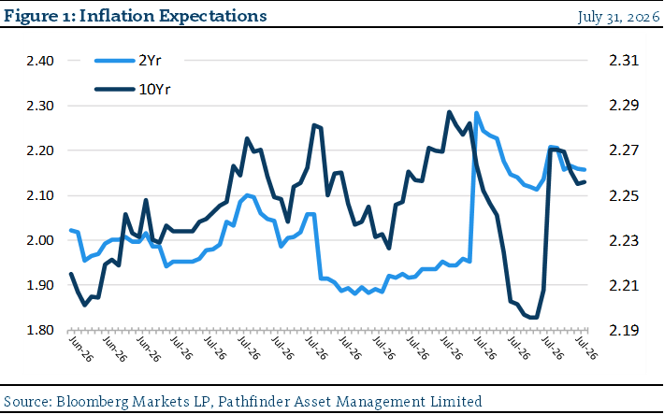
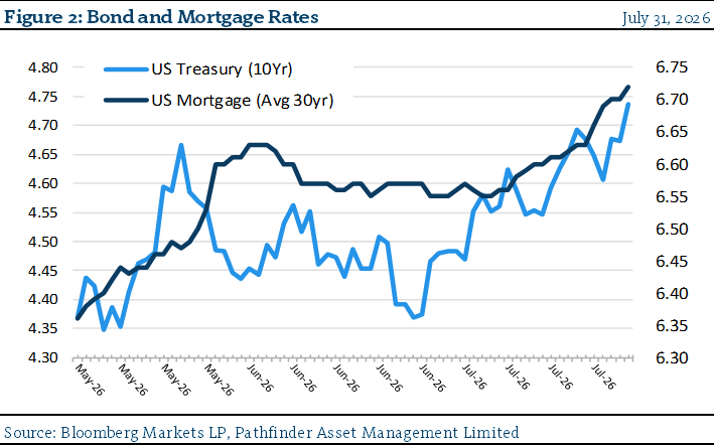
For someone who has been in this business for more than 30 years, I found this interesting. I remember listening with intense interest when Alan Greenspan was Chair of the FOMC. I could hardly understand a thing that he was saying. His “Fedspeak” made obscurity an art form, but the fog that he created rarely provoked reactions like this week (“Irrational Exuberance” aside). His words were opaque, but his actions were clear and the markets understood and trusted him. I think this was because, at that time, the Fed had a huge amount of creditability after Paul Volker tamed the massive inflation of the early 80s. After Greenspan, his replacement Ben Benanke started a period of transparency that was very popular and lasted for 20 years until the effective regime change brought in by Warsh this week.
“This means that” the credibility and independence of Chair Warsh have yet to be determined. The way that he was promoted for the position by the US administration and the dramatic and quick change in his communication style will mean that the bond market will remain unsettled until this normalizes and a level of trust can be developed. Therefore, because everything is linked, we expect financial asset volatility to continue.
National Instrument 31-103 requires registered firms to disclose information that a reasonable investor would expect to know, including any material conflicts with the firm or its representatives. Doug Johnson and/or Pathfinder Asset Management Limited are an insider of companies periodically mentioned in this report. Please visit www.paml.ca for full disclosures.
Changes in Leverage. We are increasing the asset ceiling to 2.0 times the market value of equity for Pathfinder International Fund and Pathfinder Conviction Fund to be consistent with Pathfinder Partners’ Fund and Pathfinder Resource Fund.
Telephone Call Recording Reminder. To maintain accurate records and support quality service, please note that all telephone calls with our office are recorded, in accordance with applicable privacy laws.
For more information, please follow the links above to review the fund term sheets.
*All returns are time weighted and net of investment management fees. Returns from the Pathfinder Partners’ Fund and Pathfinder Conviction Fund are presented based on the master’s series of each fund. The Pathfinder North American Equity Portfolio and The Pathfinder North American Income Portfolio are live accounts. These are actual accounts owned by the Pathfinder Chairman (Equity) and client (High Income) which contain no legacy positions, cash flows or other Pathfinder investment mandates or products. Monthly inception dates for each fund and portfolio are as follows: Pathfinder North American Equity Portfolio (January 2011), Pathfinder North American High-Income Portfolio (October 2012) Pathfinder Partners’ Fund (April 2011), Pathfinder Conviction Fund (April 2013), and Pathfinder International Fund (November 2014).
Pathfinder Asset Management Limited (PAML) and its affiliates may collectively beneficially own in excess of 10% of one or more classes of the issued and outstanding equity securities mentioned in this newsletter. This publication is intended only to convey information. It is not to be construed as an investment guide or as an offer or solicitation of an offer to buy or sell any of the securities mentioned in it. The author has taken all usual and reasonable precautions to determine that the information contained in this publication has been obtained from sources believed to be reliable and that the procedures used to summarize and analyze such information are based on approved practices and principles in the investment industry. However, the market forces underlying investment value are subject to sudden and dramatic changes and data availability varies from one moment to the next. Consequently, neither the author nor PAML can make any warranty as to the accuracy or completeness of information, analysis or views contained in this publication or their usefulness or suitability in any particular circumstance. You should not undertake any investment or portfolio assessment or other transaction on the basis of this publication, but should first consult your portfolio manager, who can assess all relevant particulars of any proposed investment or transaction. PAML and the author accept no liability of any kind whatsoever or any damages or losses incurred by you as a result of reliance upon or use of this publication.