Vancouver Housing - Part V
In the past, we have written about Vancouver residential real estate and whether we thought it was a good investment. There were two main conclusions from those reports:
- Vancouver real estate was not a good investment by traditional fundamental analysis. If you looked at the net rental yield you could earn from the asset, it was inferior to the earnings yield you could earn from owning a business or the interest yield you could earn from owning a bond. See below from 2015.
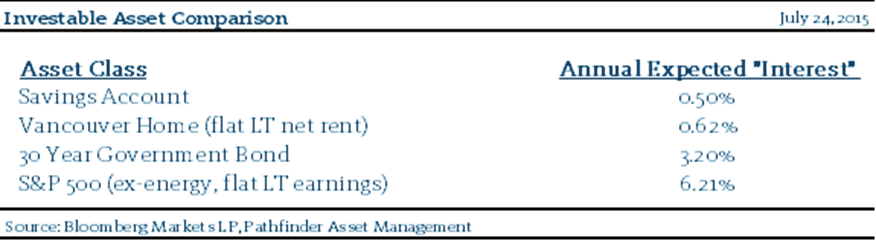
2. Vancouver real estate prices were not being driven by traditional fundamentals. Instead, they were being driven by foreign capital, potential money-laundering, ultra low interest rates, and psychological excess. We concluded that further price appreciation would be a speculation on the continuation of these factors.
Since the time of those reports, we have seen a significant change in those factors:
- Foreign Capital: There have been significant restrictions put on foreign capital. These include a 20% additional property transfer tax on foreign entities buying in metro B.C., significant vacant and speculation taxes targeted at foreign owners, and an all out foreign buyer ban in effect until 2027. Further, China has significantly clamped down on capital that was leaving its country illegally. Remember, China has a quota that a resident can only move US$50k/year out of the country.
- Interest Rates: The era of ultra-low interest rates ended after an inflation scare caused by the pandemic. Canadian mortgages are particularly vulnerable since you can only fix the interest rate for a maxium five years. When you factor 25-30 year amortizations, every Canadian mortgage is ultimately variable.
- Psychological Excess: Perhaps the biggest change has been in psychology. Vancouverites have seen that real estate prices can go down and can go down meaningfully. In addition, China has gone through a significant real estate correction and we have ground knowledge that Chinese residents have done a 180 in their psychologically towards owning real estate.
- Title Ambiguity: A factor we did not identify but perhaps the most significant is property title. Simply, the federal government recently granted the the Musquem band aboriginal title to unknown areas of metro B.C.. Further, the B.C. Supreme Court recently ruled that aboriginal title is senior to fee-simple title in a title dispute covering 1,846 acres of Richmond. In other words, there are actual risks that real estate in B.C. could be seized.
With the changes that has occurred in these factors, we are in the midst of a meaningful correction in Vancouver real estate prices. Below we list some examples:
- According to MLS, certain luxury downtown condo units have been sold at a 30-40% discount to what they were most recently purchased for. Note, certain new luxury condos have been listed at prices >40% below what they were purchased for and did not sell. When you factor unsold developer inventory and the amount of developer bankruptcies that are occuring, condos are the hardest hit. Note, this is where we saw the greatest psychological excess with presales in 2021-2022 hitting extreme valuations.
- For single-family westside homes, prices peaked in 2017 (peak of foreign capital) and have seen a meaningful correction since then. In some areas that were re-zoned for increased density, we know that developer bids are down ~50% from the peak.
- We have heard that properties on the east-side, especially duplexes, have had prices hang in better due to demand from families.
So with this correction, the obvious question is “is now a time to buy”. There are a lot of emotional, life, and financial variables to this decsion. We will answer this from a strictly financial perspective:
- Vancouver real estate is still not a good investment by traditional fundamental analysis; in fact, it might have gotten worse. When you factor the current 30-year high in vacancies, the inflation in insurance, strata, and repair costs, and all the new property focused taxes, (which comes with incremental accounting and potential legal costs) we believe this asset (in cases) produces more expenses than revenue. That’s a negative net rental yield before you factor mortgage costs. Add the new risk in title rights and we don’t believe this is a good traditional fundamental investment.
- There is likely increasing net selling pressure. Foreclosures and distressed sales are steadily increasing and will only accelerate with developer bankruptcies. While the foreign buyer ban ends in 2027, the prior foreign buyer (from China) no longer likes real estate and we expect they will be net sellers even after the ban. The change in local psychological will likely cause investor units to be put on the market. Net provincial migration into B.C is negative.
- Who is the incremental buyer? Most Vancouverites that could own, did own, and many owned multiple units. Net migration to B.C is negative and the prior foreign buyer is likely a net seller. If the remaining incremental buyer is the traditional fundamental investor, that bid is much lower than current.
“This means that” Vancouver real estate was one of the great wealth creators from ~2000 to ~2017. This created psychological excesses that were levered by an era of ultra-low interest rates and an influx of foreign capital. We’ve hit a perfect storm where these factors have all reversed. While prices are correcting, we continue to advocate owning other assets for a strictly financial store and growth of wealth.
National Instrument 31-103 requires registered firms to disclose information that a reasonable investor would expect to know, including any material conflicts with the firm or its representatives. Doug Johnson and/or Pathfinder Asset Management Limited are an insider of companies periodically mentioned in this report. Please visit www.paml.ca for full disclosures.
Changes in Leverage. We are increasing the asset ceiling to 2.0 times the market value of equity for Pathfinder International Fund and Pathfinder Conviction Fund to be consistent with Pathfinder Partners’ Fund and Pathfinder Resource Fund.
For more information, please follow the links above to review the fund term sheets.
*All returns are time weighted and net of investment management fees. Returns from the Pathfinder Partners’ Fund and Pathfinder Conviction Fund are presented based on the master’s series of each fund. The Pathfinder North American Equity Portfolio and The Pathfinder North American Income Portfolio are live accounts. These are actual accounts owned by the Pathfinder Chairman (Equity) and client (High Income) which contain no legacy positions, cash flows or other Pathfinder investment mandates or products. Monthly inception dates for each fund and portfolio are as follows: Pathfinder North American Equity Portfolio (January 2011), Pathfinder North American High-Income Portfolio (October 2012) Pathfinder Partners’ Fund (April 2011), Pathfinder Conviction Fund (April 2013), and Pathfinder International Fund (November 2014).
Pathfinder Asset Management Limited (PAML) and its affiliates may collectively beneficially own in excess of 10% of one or more classes of the issued and outstanding equity securities mentioned in this newsletter. This publication is intended only to convey information. It is not to be construed as an investment guide or as an offer or solicitation of an offer to buy or sell any of the securities mentioned in it. The author has taken all usual and reasonable precautions to determine that the information contained in this publication has been obtained from sources believed to be reliable and that the procedures used to summarize and analyze such information are based on approved practices and principles in the investment industry. However, the market forces underlying investment value are subject to sudden and dramatic changes and data availability varies from one moment to the next. Consequently, neither the author nor PAML can make any warranty as to the accuracy or completeness of information, analysis or views contained in this publication or their usefulness or suitability in any particular circumstance. You should not undertake any investment or portfolio assessment or other transaction on the basis of this publication, but should first consult your portfolio manager, who can assess all relevant particulars of any proposed investment or transaction. PAML and the author accept no liability of any kind whatsoever or any damages or losses incurred by you as a result of reliance upon or use of this publication.