We have a deal?
Earlier this week, once again, the US Administration announced its intention to complete a deal to end the war in Iran. This time it’s a 14-point memorandum of understanding to establish a temporary ceasefire to halt the 100+ day war, lift the U.S. naval blockade, reopen the critical Strait of Hormuz to global commercial shipping and provide milestones for financial incentives to allow Iran to rebuild destroyed infrastructure. The interim agreement creates a 60-day window for both nations to hammer out long-term friction points, including potential sanctions relief and verifiable limits on Iran’s enriched uranium stockpile. This breakthrough marks the fourth major attempt by the administration to broker a diplomatic framework; its three previous rounds of negotiations over the past year collapsed entirely. While the market has cheered the most recent development, we maintain a healthy level of skepticism. There are still significant issues to resolve that took years to negotiate and this situation could easily degrade into conflict again.
Figures 1 and 2 display the aftermath of the war, assuming the cease fire holds. Figure 1 presents inflation data and Figure 2 the full circle of oil prices. Figure 1 presents headline Consumer Price Index (CPI), which includes the cost of oil (light blue line), Core inflation which removes it (green line) and Personal Consumption Expenditures (PCE) data, which is the Federal Open Market Committee’s (FOMC) preferred inflation measure, which the Fed targets at 2%. As you can see, all are trending higher and will be an issue the FOMC will have to deal with in the near future.
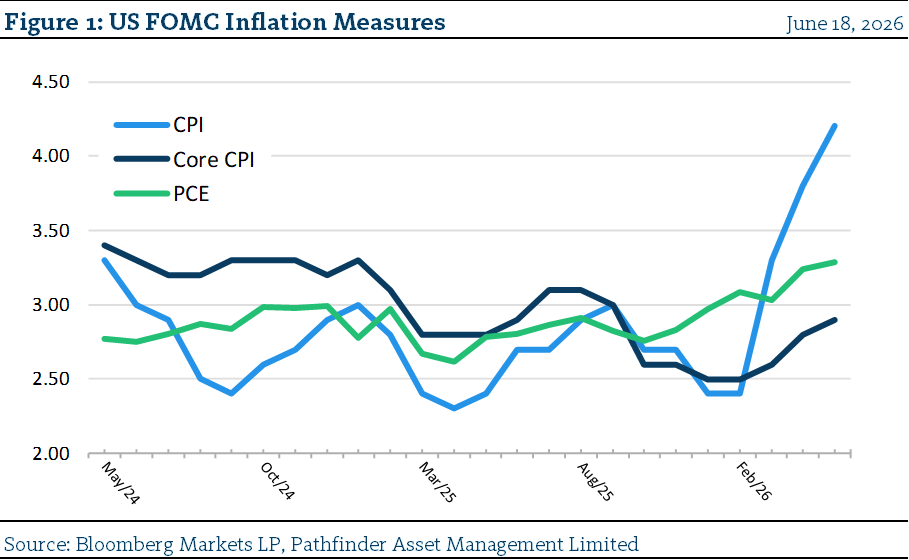
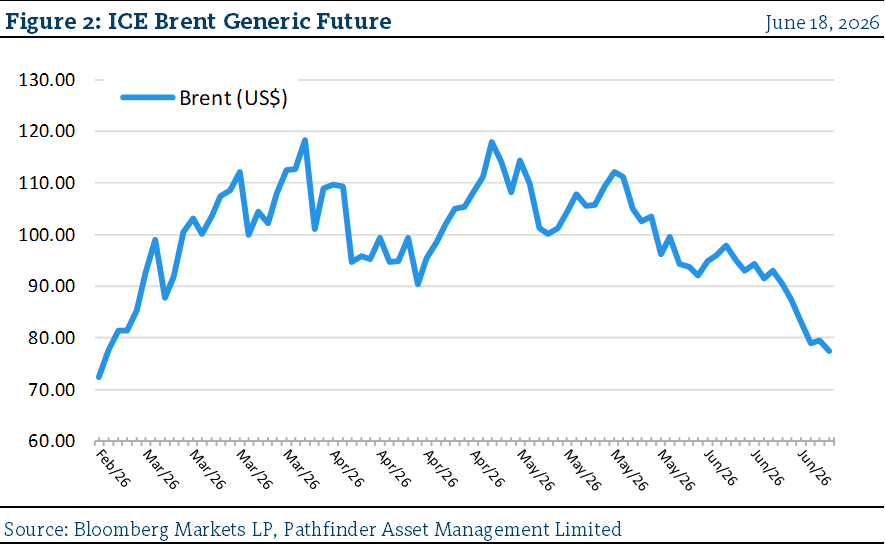
“This means that” we believe that “the risk is to the upside” in terms of inflation, bond rates, employment and the price of oil. We think the FOMC will need higher rates in order to cool the economy. At their most recent meeting, the members were split on this while their collective inflation expectations have drifted upwards. We see the potential for oil to remain higher for longer and that means inflation could become intrenched. We suspect that higher interest rates will lead to increased volatility for financial assets.
National Instrument 31-103 requires registered firms to disclose information that a reasonable investor would expect to know, including any material conflicts with the firm or its representatives. Doug Johnson and/or Pathfinder Asset Management Limited are an insider of companies periodically mentioned in this report. Please visit www.paml.ca for full disclosures.
Changes in Leverage. We are increasing the asset ceiling to 2.0 times the market value of equity for Pathfinder International Fund and Pathfinder Conviction Fund to be consistent with Pathfinder Partners’ Fund and Pathfinder Resource Fund.
For more information, please follow the links above to review the fund term sheets.
*All returns are time weighted and net of investment management fees. Returns from the Pathfinder Partners’ Fund and Pathfinder Conviction Fund are presented based on the master’s series of each fund. The Pathfinder North American Equity Portfolio and The Pathfinder North American Income Portfolio are live accounts. These are actual accounts owned by the Pathfinder Chairman (Equity) and client (High Income) which contain no legacy positions, cash flows or other Pathfinder investment mandates or products. Monthly inception dates for each fund and portfolio are as follows: Pathfinder North American Equity Portfolio (January 2011), Pathfinder North American High-Income Portfolio (October 2012) Pathfinder Partners’ Fund (April 2011), Pathfinder Conviction Fund (April 2013), and Pathfinder International Fund (November 2014).
Pathfinder Asset Management Limited (PAML) and its affiliates may collectively beneficially own in excess of 10% of one or more classes of the issued and outstanding equity securities mentioned in this newsletter. This publication is intended only to convey information. It is not to be construed as an investment guide or as an offer or solicitation of an offer to buy or sell any of the securities mentioned in it. The author has taken all usual and reasonable precautions to determine that the information contained in this publication has been obtained from sources believed to be reliable and that the procedures used to summarize and analyze such information are based on approved practices and principles in the investment industry. However, the market forces underlying investment value are subject to sudden and dramatic changes and data availability varies from one moment to the next. Consequently, neither the author nor PAML can make any warranty as to the accuracy or completeness of information, analysis or views contained in this publication or their usefulness or suitability in any particular circumstance. You should not undertake any investment or portfolio assessment or other transaction on the basis of this publication, but should first consult your portfolio manager, who can assess all relevant particulars of any proposed investment or transaction. PAML and the author accept no liability of any kind whatsoever or any damages or losses incurred by you as a result of reliance upon or use of this publication.